The Open Hand and the Full Life: What Monastic Availability Reveals About Our Scarcity of Time
There is a particular kind of anxiety that afflicts the modern American professional. It announces itself in the language of calendars — in the blocked hours, the defended lunch breaks, the auto-replies that declare one's unavailability with barely concealed aggression. Time, we have decided, is a finite personal resource, and anyone who reaches for it without an appointment is, in some sense, a thief.
The monks of the medieval Benedictine tradition would have found this posture deeply strange.
Not because they had unlimited hours — they did not. Not because their days were unstructured — they were, in fact, exquisitely ordered. But because the organizing logic of their time was fundamentally different from ours. Where we treat each hour as a unit of personal capital to be allocated, the monastic tradition treated time as something that belonged, first and finally, to God — and by extension, to whoever God sent to the monastery door.
When Interruption Was the Schedule
The Rule of Saint Benedict, written in sixth-century Italy and still observed in monasteries across the United States today, devotes an entire chapter to the reception of guests. "All guests who present themselves are to be welcomed as Christ," it instructs. This was not a sentiment. It was an operational directive.
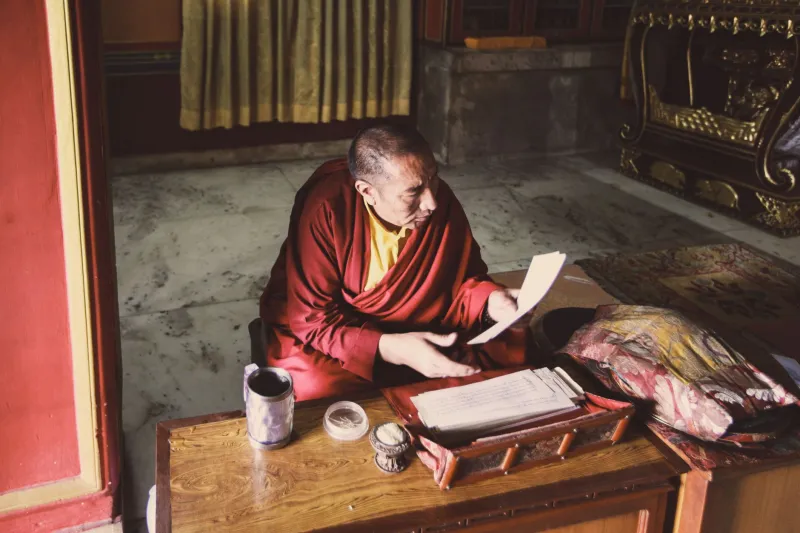
A monk engaged in lectio divina — the slow, contemplative reading of sacred texts — was expected to set his book down when a stranger arrived. A brother at manual labor would pause his work. The abbot himself was understood to hold his own schedule loosely, because the needs of the community and its visitors were not interruptions to his vocation. They were his vocation.
What this meant, in practical terms, was that medieval monks did not experience time in the way we do. They had no concept of "personal time" as a protected category distinct from communal time. The hours of the Divine Office, the hours of work, the hours of rest — all of it was offered, not hoarded. The self that might wish to defend its afternoon was gradually, deliberately dissolved through years of practice.
The Scarcity Illusion
Modern productivity culture is built on a premise that feels like common sense: there are only twenty-four hours in a day, and if you do not protect yours, others will consume them. From this premise flows an entire industry — time-blocking systems, calendar management tools, boundary-setting workshops, and the peculiar social ritual of announcing how busy one is as proof of one's importance.
The premise is not wrong, exactly. Time is finite. But the conclusion drawn from it — that vigilant defense of personal time produces a richer, more present life — is far less certain than we pretend.
Research in psychology has repeatedly found that people who feel chronically time-scarce do not necessarily have fewer hours than those who feel time-affluent. They have a different relationship to the hours they possess. The perception of scarcity, not the fact of it, drives the anxiety. And the behaviors that scarcity anxiety produces — the constant optimization, the resentment of unplanned demands, the fragmented attention of someone always calculating what this moment is costing them — tend to make a person feel more depleted, not less.
The monk who paused his reading to welcome a guest did not keep a mental ledger of lost minutes. He was fully present to the guest, fully present afterward to his book, and untroubled by the transition between them. This is not romanticization. It is a description of what happens when time is no longer experienced as something that can be stolen from you.
Availability as Spiritual Technology
It would be a mistake to read monastic availability as mere selflessness — as the monk simply subordinating his needs to everyone else's. The tradition understood something more subtle: that the defended self, the self perpetually managing its exposure to others, is a self that never fully arrives anywhere.
Contemporary mindfulness teachers often speak of presence as something to be cultivated in quiet, protected moments. The monastic insight is more demanding and, ultimately, more liberating. Presence is not a state achieved in solitude and then carried into interaction. It is practiced precisely in the moment of availability — in the willingness to be genuinely here, with this person, without the background hum of what I am losing by being here.
This is why the great monastic writers so consistently describe the life of availability not as exhausting but as expansive. Thomas Merton, the twentieth-century Trappist monk whose journals remain among the most widely read contemplative texts in America, wrote at length about the paradox of monastic time: that the hours given away seemed, mysteriously, to multiply. Not in any literal sense, but in the sense that a life organized around openness felt fuller, more inhabited, than one organized around protection.
What This Might Mean for Us
None of this is an argument for abandoning structure or for pretending that unlimited availability is either possible or wise in a life that includes professional obligations, family demands, and genuine needs for rest. The monastery itself was structured. The point is not chaos. The point is the underlying orientation — the posture of the open hand versus the clenched fist.
A few questions are worth sitting with.
When you feel that your time has been "taken," what is the self that believes itself robbed? Is it the self that is genuinely depleted, or the self that has learned to experience any unplanned demand as a threat?
When you block time on your calendar, what are you protecting — genuine rest and renewal, or the illusion of control over something that was never fully yours to control?
And when you are with another person — a colleague, a family member, a stranger who needs a moment of your attention — are you present to them, or are you elsewhere, calculating the cost?
The monastic tradition does not promise that availability will be comfortable. It promises something stranger and more worthwhile: that the self willing to be available will discover, over time, that it was never as scarce as it feared.
The Practice of the Open Hour
For those drawn to explore this terrain, the monastic tradition offers something more concrete than philosophy. It offers practice.
Begin, perhaps, with a single hour each week designated not for productivity and not for rest, but for availability — time held open with no agenda, no defended purpose, ready to be given to whatever or whoever arrives. Sit with the discomfort that this produces. Notice the impulse to fill the space, to optimize it, to make it useful in some measurable way.
Then notice what happens when you do not.
The monks were not naive about the value of time. They were, by most measures, extraordinarily productive — they preserved Western literature, developed agricultural techniques, built institutions that outlasted empires. But they accomplished this not by treating time as a personal asset to be maximized, but by treating it as a gift to be received and offered, again and again, with an open hand.
In a culture that has made scarcity its governing metaphor, that remains a quietly radical proposition.