One Door, Many Rooms: What Monastic Commitment Teaches Us About the Paralysis of Infinite Choice
Somewhere around the age of thirty, many Americans find themselves in possession of everything the culture promised would feel like freedom: multiple career trajectories, a curated portfolio of side projects, a LinkedIn profile bristling with acquired skills, and a nagging, persistent sense that they have not yet truly begun. The options remain open. The self remains provisional. And beneath the surface of all that carefully preserved possibility, something quieter goes unacknowledged — the exhaustion of never having fully arrived anywhere.
Monks made a different calculation. And the more carefully one examines that choice, the harder it becomes to dismiss it as mere renunciation.
The Vow as Liberation
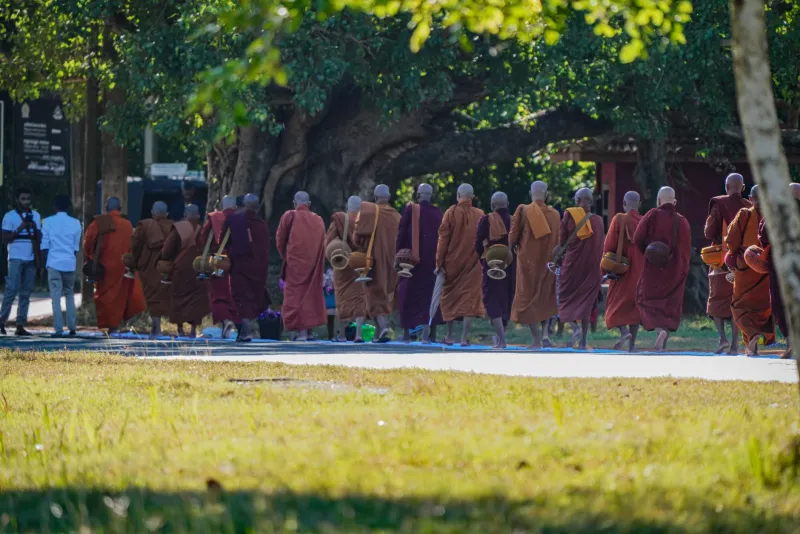
When a Benedictine novice takes his final vows, he does not merely commit to a set of rules. He forecloses entire categories of his future. He will not pursue another career. He will not relocate in search of better opportunities. He will not reinvent himself in response to the cultural moment. The deliberate closure of these doors is not incidental to his formation — it is the very mechanism of it.
This runs directly against the grain of contemporary American self-understanding. The dominant cultural narrative frames optionality as virtue. Keeping choices open is treated as intelligence; commitment is treated as risk. The result is a population of adults who are, in the language of psychologist Barry Schwartz, not liberated by choice but tyrannized by it — perpetually surveying the menu, never quite eating.
What the monastic tradition understood, with a clarity that modern behavioral science is only now catching up to, is that the human psyche does not flourish in the presence of unlimited possibility. It flourishes in the presence of depth. And depth is only achievable through the sustained, unglamorous act of going further into a single thing rather than perpetually wider across many.
The Cost of the Unlived Commitment
The philosopher Søren Kierkegaard wrote that anxiety is the dizziness of freedom. He meant something precise by this: that the very awareness of all one could become generates a kind of vertigo that makes genuine movement nearly impossible. Contemporary Americans live inside that vertigo daily, often without recognizing it for what it is.
Consider what the culture of perpetual optionality actually produces. The professional who pivots every three years accumulates breadth but rarely the kind of mastery that comes only from a decade of sustained attention to a single domain. The person who delays relational commitment in the name of self-discovery often discovers, in middle age, that the self they were preserving space for never quite materialized. The spiritual seeker who samples traditions — a weekend of Zen here, a Vipassana retreat there, a flirtation with Stoic philosophy — may accumulate a rich vocabulary of transformation while remaining, at the level of actual practice, a permanent beginner.
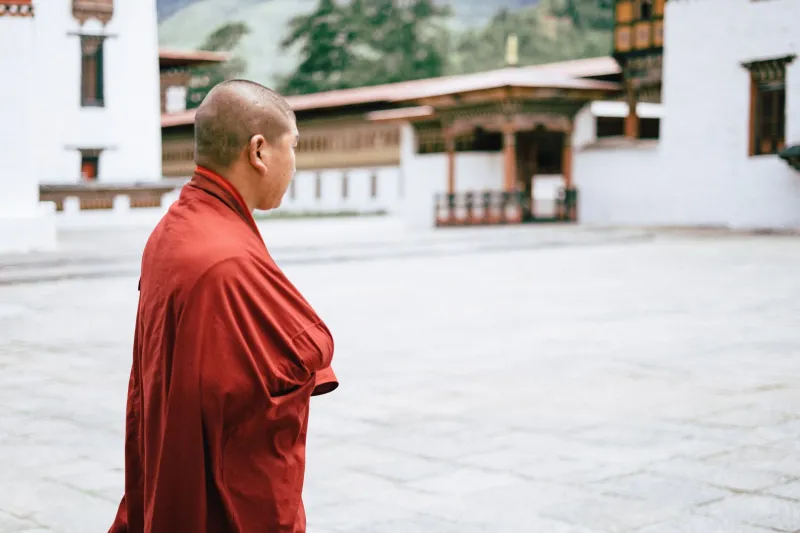
Monks were not naive about this. The Rule of Saint Benedict is, among other things, a sophisticated psychological document. Its insistence on stability — the vow that binds a monk to a particular community for life — was not arbitrary austerity. It was a recognition that the self deepens not by escaping its circumstances but by pressing into them. The monastery's walls were not a cage. They were a container within which genuine interiority could develop.
Mastery and the Narrowed Life
There is a paradox at the center of monastic experience that Western modernity finds genuinely difficult to process: the more completely a monk surrendered the breadth of his possible lives, the richer and more expansive his inner life became. The narrowing of external options corresponded, over time, to an extraordinary widening of interior space.
This is not mysticism. It is, in part, simple cognitive economics. Attention is finite. Every choice kept open requires a portion of one's cognitive and emotional resources to maintain — to periodically revisit, to defend against the anxiety of abandonment, to keep warm against the possibility of future need. The monk who has vowed away those alternatives is not impoverished by their absence. He is freed from the maintenance cost of their possibility. That reclaimed attention becomes available for something else: the slow, difficult, irreplaceable work of going deeper.
This is precisely what the contemporary self-optimization industry cannot sell, because it cannot be packaged. It is not a technique. It is not a morning routine or a productivity framework. It is the accumulated consequence of sustained fidelity to a single direction, practiced over years and decades, in the presence of difficulty and boredom and occasional doubt.
What Foreclosure Actually Feels Like
It would be dishonest to romanticize the monastic path without acknowledging what it costs. Monks who have spoken candidly about the interior life describe moments — sometimes extended seasons — of grief for the roads not taken. The vow of celibacy is not painless. The vow of stability is not always peaceful. The Rule does not promise comfort. It promises formation.
This distinction matters enormously for the lay person attempting to draw wisdom from the monastic tradition without entering it. The goal is not to manufacture artificial constraints for their own sake, nor to mistake limitation for discipline. The goal is to interrogate, with genuine seriousness, the question of what one actually wants to go deep into — and then to practice something like fidelity to that answer, even when the cultural wind blows in the opposite direction.
For most Americans, this will not look like taking vows. It will look quieter and more ordinary: choosing a craft and returning to it when novelty loses its shine, committing to a community rather than perpetually auditing one, following a contemplative practice past the point of early enthusiasm into the less glamorous territory where real change occurs. It will look, in short, like choosing one door and walking through it — not because the other doors are worthless, but because no room is ever truly entered by someone standing in the hallway.
The Practice of Chosen Limits
The monk's wisdom, distilled for a culture that will not take vows, is essentially this: the self is not found by keeping all options open. It is found by going somewhere completely. The psychological freedom that monastic commitment produces is not available to those who treat every choice as reversible, every path as provisional, every identity as a draft pending revision.
Begin, then, with a single honest question: what have you been circling for years without landing? What practice, vocation, relationship, or community has held your attention long enough to deserve more of it than you have given? The monastic tradition does not ask you to be certain before you commit. It asks you to understand that certainty is not the prerequisite for depth — commitment is.
One door. Many rooms. This has always been the architecture of a life genuinely lived.