The Art of Sacred Listening: How Monastic Communities Cultivated the Skill That Modern Wellness Forgot
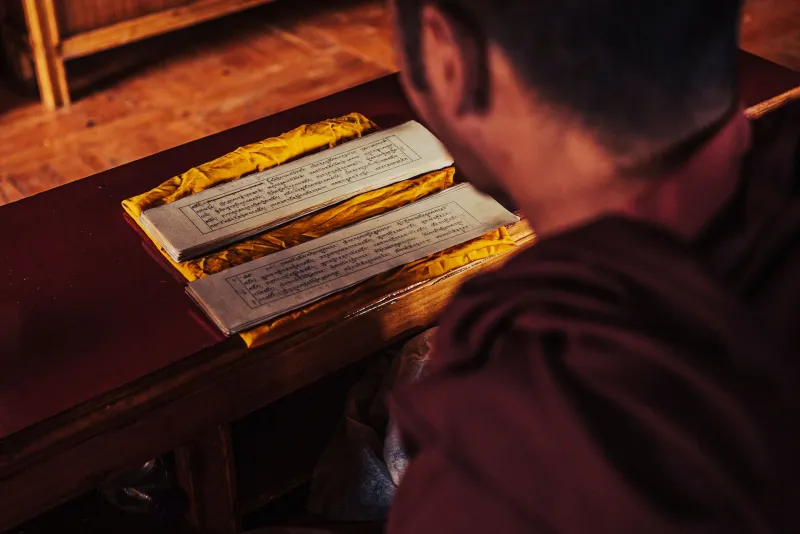
The opening word of the Rule of Saint Benedict is not pray. It is not contemplate or surrender or seek. It is obsculta — Latin for listen. This is not incidental. In the Benedictine tradition, listening is not preparatory to spiritual practice. It is the practice, positioned at the very threshold of the entire monastic vocation.
That a fifteen-hundred-year-old document opens with an imperative to listen tells us something significant about what the contemplative tradition has always understood and what contemporary American wellness culture has, by and large, quietly set aside.
The Difference Between Hearing and Listening
To hear is involuntary. Sound waves reach the ear, the auditory nerve fires, the brain registers input. Hearing requires nothing of us. Listening — genuine, sustained, receptive listening — requires a great deal.
Monastic communities have long distinguished between these two modes, and the distinction shapes everything from how scripture is received during the Liturgy of the Hours to how a senior monk hears a junior member's confession of difficulty. Hearing is biological. Listening is a spiritual act, one that demands the subordination of the self's internal chatter to the reality of what is actually present.
In the broader American wellness landscape, this distinction has been largely collapsed. Mindfulness practices — valuable as many of them are — tend to orient attention inward, toward the breath, the body scan, the field of personal sensation. This is not a criticism. Inward attention is genuinely restorative. But it represents only half of the contemplative inheritance available to us. The other half — the half that faces outward, toward the world and toward others — is the practice of listening, and it has received comparatively little attention in the mainstream wellness conversation.
Lectio Divina: Listening as an Act of Surrender
Perhaps the most structured expression of contemplative listening in the Western monastic tradition is lectio divina, or sacred reading. The term is somewhat misleading to modern ears: this is not reading in the way we typically understand it. It is, more precisely, a form of listening to a text.
The practice involves reading a passage of scripture or sacred writing slowly — often aloud — and then resting in it. Not analyzing. Not extracting takeaways. Not journaling immediate reactions. Simply allowing the words to be present, returning to them as one returns to breath in meditation, and waiting for something to emerge from the encounter.
The theological underpinning is that the text is alive, that it speaks differently in different moments, and that the practitioner's role is not to master the material but to be addressed by it. This requires a posture of genuine receptivity — a willingness to be changed by what one hears rather than merely informed by it.
For practitioners outside a religious context, the structure of lectio divina remains instructive. It is a training in the tolerance of not-knowing, in the capacity to remain present with something longer than the mind's initial restlessness demands. These are not narrowly theological skills. They are foundational capacities for emotional intelligence, relational depth, and the kind of sustained attention that modern life systematically erodes.
Listening to Silence
There is a second form of monastic listening that is perhaps even more counterintuitive to contemporary sensibilities: listening to silence itself.
In many contemplative communities — Trappist monasteries being among the most well-known in the United States — extended silence is not merely the absence of noise. It is treated as a presence, a medium through which something beyond ordinary cognition becomes perceptible. The monk who sits in the chapel at four in the morning is not simply waiting for the Office to begin. He is, in a very real sense, listening.
This may sound abstract. But there is a growing body of research in neuroscience and psychoacoustics that lends it unexpected support. Studies conducted at the National Institutes of Health and elsewhere have found that periods of silence — genuine silence, not simply reduced noise — activate the brain's default mode network in ways that promote integration, consolidation of experience, and what researchers sometimes describe as the processing of unresolved material. The nervous system, it appears, uses silence to do work that it cannot do in the presence of constant stimulation.
Monastics have been empirically observing this for centuries. They simply described it in different language.
Listening to Others: The Forgotten Relational Practice
A third dimension of monastic listening is relational, and it may be the most immediately applicable for those living outside contemplative communities.
The role of the spiritual director — a senior practitioner who listens to a directee's interior experience over time — is one of the most demanding listening practices the tradition has produced. The director does not primarily advise. He or she listens, and in listening, creates a quality of space in which the directee's own deeper knowing can emerge. The Quaker tradition describes something similar in the practice of clearness committees, where a group of friends gathers not to offer solutions but simply to ask honest, open questions and then listen.
What these practices share is a radical commitment to the other person's experience as worthy of full attention. Not partial attention. Not attention divided between listening and formulating a response. Full attention, offered without agenda.
Research in relational psychology consistently finds that the experience of being genuinely heard — not agreed with, not advised, simply heard — is among the most therapeutically powerful interpersonal experiences available. It reduces cortisol levels, increases oxytocin, and generates a sense of safety that opens the nervous system to change. The monastery, without the benefit of modern neuroimaging, arrived at this conclusion through centuries of careful observation.
Cultivating the Practice at Home
For those wishing to introduce a more intentional listening practice into daily life, the monastic tradition offers several accessible entry points.
Begin with text, not breath. Choose a short passage — from any tradition that resonates — and read it aloud slowly, twice. Then sit with it in silence for five minutes. Do not analyze. Simply listen for what, if anything, continues to move in you.
Practice conversational listening without agenda. In one conversation each day, commit to asking one genuine question and listening to the full response before speaking again. Notice the impulse to redirect, to relate, to advise. Simply let it pass.
Introduce a daily period of intentional silence. This need not be long. Ten minutes in the morning, before the first screen is consulted, spent in simple, receptive quiet. Not meditation with a technique. Just quiet, offered as a form of attention.
These are modest beginnings. The monastic tradition would not pretend otherwise. But it would also affirm, with considerable confidence, that the capacity to listen — to text, to silence, to others, and ultimately to the deeper movements of one's own interior life — is not a supplement to contemplative practice.
It is, as Benedict understood from the very first word, where the practice begins.