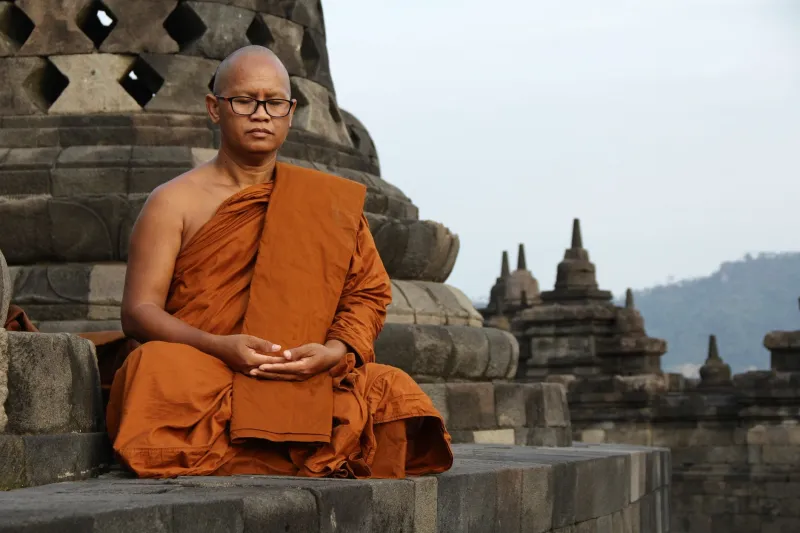
When Progress Becomes the Problem: What Monks Knew About the Danger of Measuring Your Inner Life
The Dashboard That Wasn't There
Open nearly any popular meditation app today and you will find it: a streak counter, a minutes-logged display, a progress chart rendered in soothing gradients. The implicit message is unmistakable. You are building something. You are accumulating something. You are, in the language of Silicon Valley, shipping.
This framing would have bewildered the monks of the early Christian desert. It would have confused the Zen masters of Tang Dynasty China. It would have struck the Benedictines of sixth-century Italy as a category error so fundamental it barely warranted a response. The interior life, for these practitioners, was not a project to be managed. It was a condition to be inhabited — slowly, humbly, and without the anxious need to verify that inhabiting it was going well.
Something important has been lost in translation. And the loss is costing us more than we recognize.
How Efficiency Colonized Contemplation
The United States has always been a nation that trusts the measurable. From Benjamin Franklin's moral ledger — in which he tracked his daily performance against thirteen virtues — to the modern biohacker's obsessive logging of sleep cycles and heart rate variability, Americans have consistently reached for quantification as a means of self-improvement. It is a cultural reflex, and in many domains it serves us reasonably well.
But contemplative practice is not a domain that yields to metrics. The moment you begin asking how much you meditated, or how well your session went, or whether today's sit was more productive than yesterday's, you have introduced a evaluative gaze into a space that was specifically designed to be free of one. You have, in a meaningful sense, left the practice behind and entered a performance of the practice.
This distinction matters enormously. Meditation, in its traditional forms, was never about generating states that could be reported back to a dashboard. It was about cultivating a quality of presence that gradually, imperceptibly, and often invisibly reorganized the practitioner's relationship to their own experience. That kind of transformation does not produce data points. It produces a different kind of person — and usually only long after anyone stopped looking for signs of change.
The Monastic Refusal to Keep Score
In the Rule of Saint Benedict, written around 516 CE and still governing the daily rhythms of Benedictine communities across America today, there is a striking absence. The Rule is meticulous about time, about labor, about hospitality, about the proper conduct of prayer. What it does not contain is any mechanism for monks to evaluate their spiritual progress against a standard, report their interior achievements to a superior, or compete — even privately — with one another's advancement.
This was not an oversight. It reflected a deeply considered theological and psychological intuition: that the moment a practitioner begins monitoring their own spiritual development, they introduce the ego into the very space where the ego's loosening is the whole point. The observer and the observed collapse into one another, and what was contemplation becomes self-consciousness.
The desert fathers of fourth-century Egypt were even more direct. When disciples came to the elders seeking confirmation that their prayer was progressing, the elders routinely refused to provide it. Not out of cruelty, but out of wisdom. "Do not seek to know whether you are advancing," one saying runs. "Seek only to be present." The distinction is not semantic. It is the entire practice.
Zen teachers in the Japanese tradition held a similar line. The student who arrived claiming to have achieved some breakthrough was typically met with skepticism or silence. The student who arrived confused, uncertain, and unable to report anything at all was often told they were right on time.
What Optimization Actually Produces
Consider what happens, practically speaking, when a meditator begins treating their practice as something to be optimized. They develop preferences — for certain states over others, for sessions that feel productive over sessions that feel dry or difficult. They begin to subtly steer their experience, reaching for the quality of attention that previously felt rewarding and pulling away from the discomfort that feels like failure.
In doing so, they have fundamentally misunderstood the practice. The difficult sessions — the ones where the mind will not settle, where boredom is overwhelming, where nothing feels like it is happening — are not inferior sessions. In many contemplative frameworks, they are the most important ones. They are the sessions in which the practitioner's relationship to discomfort, to impermanence, and to the uncontrollable nature of experience is most directly confronted.
Optimization, by its nature, tries to eliminate exactly this kind of friction. And in eliminating it, it eliminates the practice's most transformative terrain.
Sitting Without an Agenda
The phrase most commonly used in traditional Zen instruction for the act of seated meditation is shikantaza — a Japanese term that translates, roughly, as "just sitting." Not sitting-in-order-to, not sitting-while-tracking, not sitting-toward-some-goal. Just sitting. The instruction contains its own corrective. The moment you add a purpose beyond the sitting itself, you are no longer doing shikantaza. You are doing something else that happens to involve a cushion.
This teaching is not unique to Zen. The Christian contemplative tradition speaks of apophatic prayer — a form of inner silence that deliberately strips away not just words and images, but even the desire for particular spiritual outcomes. The fourteenth-century English text The Cloud of Unknowing instructs its reader to place all concepts, all progress, all spiritual consolations beneath a figurative cloud and simply remain. Not seeking. Not measuring. Not even hoping for a particular result.
For Americans conditioned to believe that effort without measurable output is wasted effort, this is genuinely difficult to internalize. It can feel irresponsible. It can feel lazy. It can feel like you are doing it wrong.
That discomfort, the traditions suggest, is itself worth sitting with.
Reclaiming the Practice from the Productivity Trap
None of this means that consistency is unimportant, or that showing up regularly to your cushion does not matter. It does. The monastic traditions were, if anything, more rigorous about regularity than any app-based streak counter. Monks did not skip the Divine Office because they were not in the mood. They showed up.
But they showed up without a scorecard. They showed up understanding that the fruits of contemplative practice are rarely visible to the practitioner in the moment of practice, and often not visible to anyone at all. The transformation is quiet. It shows up in how you respond to a difficult conversation, in the quality of your attention during an ordinary afternoon, in a gradually expanding capacity to remain present when presence is hard.
None of that will register on a dashboard. None of it can be tracked across a weekly bar chart. And that, the monks would tell you, is precisely the point.
If you find yourself opening a meditation app and feeling a faint anxiety about whether today's session will be as good as yesterday's, that anxiety is worth examining. It is not a sign that you need to try harder. It is a sign that you may have confused the practice with a performance of the practice — and that the most productive thing you can do is quietly, deliberately, and without fanfare, put the scorecard down.